US deploys third carrier to Middle East amid stalled Iran war
The arrival of the USS Theodore Roosevelt marks a significant increase in American naval presence in the region as President Trump weighs his next moves in the ongoing conflict.
By Luis Hoffmann ·
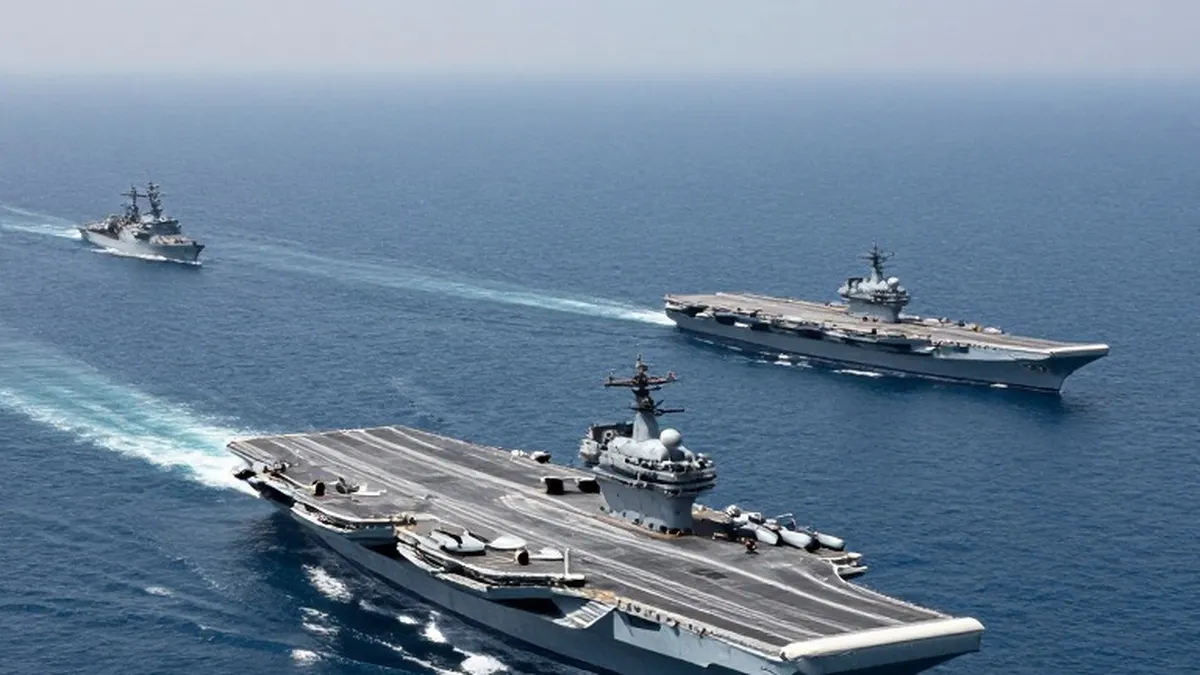
US Central Command announced on Monday that a third American aircraft carrier has arrived in the Middle East. This deployment represents a substantial show of force by the United States as President Donald Trump considers his options for the next phase of the war with Iran.
The USS Theodore Roosevelt brings thousands of additional personnel to the region. President Trump has recently shifted his public stance, alternating between threatening further large-scale attacks on Iran and asserting that the conflict, which has lasted more than eight months, is militarily effectively over.
The Roosevelt departed from San Diego in September. It now joins the USS George HW Bush and the USS George Washington, which are already stationed in the area to enforce a naval blockade on Iranian shipping. The George HW Bush arrived in April, while the George Washington arrived in August. The Navy notes that this is the first time since 2003 that three carrier strike groups have been present in the Middle East simultaneously.
According to the Navy, the flotilla in the Arabian Sea now comprises 13 destroyers, two cruisers, and a littoral combat ship. Additionally, two more destroyers are positioned in the Red Sea. The Roosevelt was deployed alongside the USS Makin Island amphibious readiness group, which includes the USS John P Murtha and USS Anchorage landing ships. Approximately 2,000 marines are part of this group, though those ships have not yet reached the region.
This military buildup comes nearly two weeks after the midterm elections. Voters inflicted significant losses on the Republican party, a result driven partly by the unpopularity of the Iran war and its economic impact. These results prompted Vice President JD Vance to publicly distance himself from the President regarding the conflict, stating on social media that the war was the reason for the party's defeat.
Despite the political fallout, President Trump maintains that the decision to engage was correct. He has not ruled out restarting the conflict, which has been in a stalemate for several months. Last week, he warned Iran that the US military is ready and monitoring Pickaxe Mountain, a facility linked to Iran's nuclear program, for any signs of activity.
In an interview with conservative broadcaster Hugh Hewitt on Thursday, Trump said he would not hesitate to act if negotiations failed. However, he also told reporters that he believed it was highly unlikely he would order new major strikes. He declared that the war is militarily effectively over following a meeting with the Prime Minister of Qatar.
Trump has stated that the US no longer requires a deal with Tehran. He has directed Vice President Vance, who previously served as a key negotiator in ceasefire talks, to focus on the administration's domestic anti-fraud campaign in Democratic-controlled areas. Negotiations have stalled due to disagreements over Iran's nuclear program, which Trump insists must be part of any final agreement. Iran, meanwhile, wants the US to agree to core conditions first, including lifting the naval blockade that prevents its oil from reaching global markets.
The Strait of Hormuz remains a critical flashpoint in the simmering conflict. This waterway carried a fifth of the world's oil before the war began. Commercial ships continue to face risks and attacks, while the US conducts limited strikes on Iranian targets near the strait and assists in guiding vessels through the contested waters.
Iranian state television warned shipping companies on Monday that the US-supported route through the waterway is dangerous due to mines. The revolutionary guard's navy reported that mines damaged six oil tankers since Sunday, causing pollution along the coastlines. Separately, a projectile struck a tanker attempting to transit the strait, causing an engine room fire, though no casualties were reported according to the UK Maritime Trade Organization.
US Central Command reported that it has redirected 150 merchant vessels and disabled five others since June under the blockade. Independent data from Lloyd's List indicates that traffic through the strait remains at less than a third of prewar levels.