SS United States Sunk Off Florida, Becoming World's Largest Artificial Reef
The record-breaking American ocean liner was scuttled in the Gulf of Mexico off Destin, Florida, where it will serve as a dive site and marine habitat on the Florida Panhandle Shipwreck Trail.
By Ahmed Russo ·
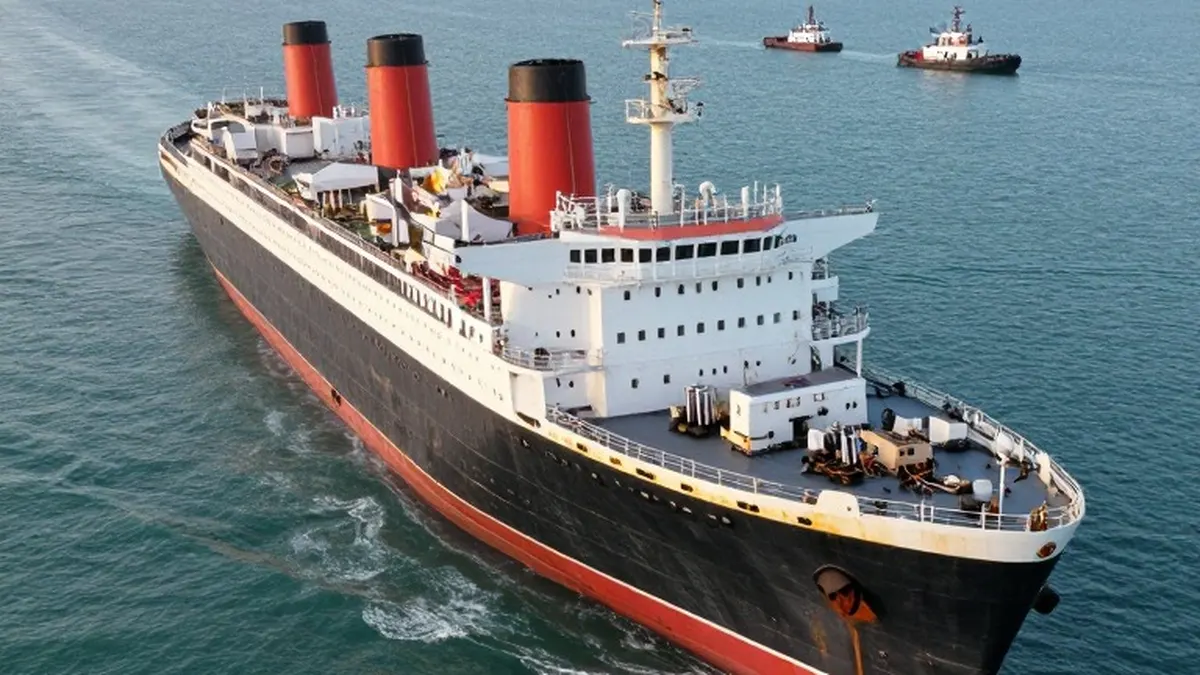
The SS United States, the celebrated American ocean liner that once set transatlantic speed records, began a new chapter on Wednesday as the largest artificial reef in the world. The vessel was submerged roughly 25 miles off the coast of the Florida Panhandle after its valves were opened this month.
According to 6abc News, the controlled scuttling in the Gulf of Mexico off Destin, Florida, began around 1 p.m. The final descent took about nine hours, far longer than the single hour that had been expected, before the ship settled onto the sand some 180 feet below the surface.
The 990-foot luxury passenger ship was larger than the Titanic and reached a top speed of 44 mph during sea trials. Because it was also viewed as a military asset, its cost of more than $70 million was divided among the Transportation Department's Maritime Administration, the US Navy and the commercial United States Lines when construction began in 1950, according to the Naval Historical Foundation.
Despite its historic achievements, the liner's golden age was brief. "Its fate was sealed in 1958 with the introduction of the commercial jet liner, which replaced the ocean liner as the primary means to cross the Atlantic," Sal Mercogliano, a maritime historian and professor at Campbell University, told CNN. As air travel drew passengers away, the ship was retired in 1969 after less than two decades of crossings. "Her sinking will mark the end of the great ocean liners," Mercogliano said.
After its retirement, the vessel sat at several Atlantic ports while successive owners weighed its fate, CNN reported. Facing eviction in 2024 from the Philadelphia shipyard where it had been tied up for 30 years, its owners had to choose between selling it for scrap or selling it to become an artificial reef. Okaloosa County, Florida, stepped in with a $1 million bid, according to the county's website. In early 2025, after several delays, crews towed the ship 1,800 miles from Philadelphia to Mobile, Alabama, where hazardous materials were stripped out. The conservancy said most of the interior was gutted before that trip, while the hull retains 90% of its original integrity.
The liner is now the 21st and largest vessel on the Florida Panhandle Shipwreck Trail, which spans roughly 150 miles from Pensacola to Port St. Joe. The trail, whose wrecks date back to 1942, was officially established in 2012 as part of an effort to boost tourism after the 2010 Deepwater Horizon oil spill and has since become a haven for marine life and recreational scuba divers. The SS United States surpasses the trail's previous giants, including the sunken aircraft carrier USS Oriskany, by nearly 80 feet.
Marine scientists expect the hull to quickly become the center of a thriving ecosystem on the Gulf floor. "Fish will start congregating around a new artificial reef within hours or days," Michael Parsons, professor of marine science at Florida Gulf Coast University in Fort Myers, told CNN, adding that bacteria and algae will colonize the ship almost immediately. According to the trail's website, earlier wrecks have attracted snapper, grouper, amberjack, angelfish and barracuda, as well as sea urchins and corals.
Prof. Chris Stallings, a professor of biological oceanography at the University of South Florida in Tampa, told CNN that a reef's effectiveness depends on why it was deployed. "Artificial reefs are tools, not inherently good or bad solutions," he said. Okaloosa County is promoting the wreck as an environmental and economic boost, and Stallings noted that artificial reefs can support recreational and charter fishing, dive operations, boat and fuel sales, and hotels and restaurants serving visiting tourists.
In its heyday, CNN called the ship "the most prestigious way to cross the Atlantic." Four men who were US presidents at some point sailed on it: Harry Truman, Dwight Eisenhower, John F. Kennedy and Bill Clinton. Its staterooms also hosted Hollywood and international royalty, including Marlon Brando, Sean Connery, Marilyn Monroe, Judy Garland, Prince Rainier of Monaco and the Duke and Duchess of Windsor. Designed for rapid conversion to troop transport, the ship could carry up to 14,000 troops instead of its usual 1,900 to 2,000 passengers.
The SS United States Conservancy, the nonprofit that cared for the vessel and preserved its history, plans to build a museum in Florida near dive embarkation sites, displaying artifacts that include the ship's two large funnels, which were removed before the sinking. Recreational divers with open-water certification can already access the wreck's upper deck, which may sit only 55 to 60 feet below the surface because of the ship's size, according to the Okaloosa County Tourism Department, though access will depend on the wreck's final position, currents, visibility and local safety rules.