Nvidia Scandal and Chip Wars Reshape China's AI Strategy
The resignation of Nvidia CEO Jensen Huang and ongoing US export controls are forcing China to accelerate its development of domestic AI chip capabilities.
By Luis Hoffmann ·
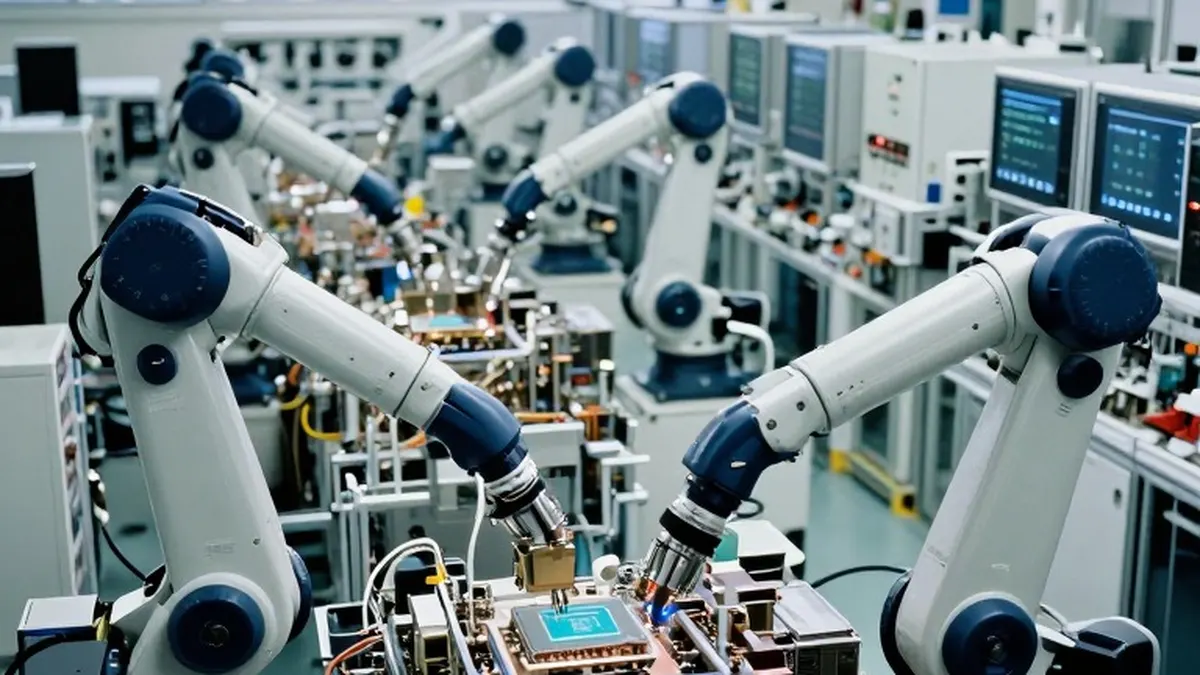
China is pursuing an ambitious goal to lead the global artificial intelligence race, a mission that relies heavily on access to cutting-edge semiconductors. Vice Premier Ding Xuexiang, who heads the Communist Party's Commission on Science and Technology, has been charged with boosting the nation's technological innovation capabilities. This effort aims to enhance Beijing's strategic competitiveness against the United States, which currently holds a significant lead in chip design and manufacturing technology.
The Chinese government is deploying AI across various sectors, from monitoring citizens and developing unmanned weapons systems to transforming industries through robotics. To protect its dominance, Washington has implemented a series of measures to limit China's access to critical hardware. As early as 2023, the Biden administration restricted the export of advanced semiconductors and related equipment, citing national security concerns. Beijing criticized these moves as unilateral and arbitrary, yet American chipmakers remain attracted to China's vast and rapidly expanding market.
The recent departure of Jensen Huang from the CEO role at Nvidia has intensified the geopolitical tension. The 63-year-old executive, who was born in Taiwan and enjoyed significant popularity in China, served as a key AI adviser to President Donald Trump during his second term. Huang advocated for relaxed regulations on selling AI chips to China. In December, the Trump administration allowed Nvidia to ship its H200 chips to the country, conditional on Washington receiving 25 percent of the sales revenue. Although the H200 is not the highest-performance model, it offers significantly better efficiency than competing domestic Chinese products.
The H200 chip carries a price tag of approximately $27,000. Nvidia estimates that demand in China could reach 2 million units, representing roughly $5.4 billion in sales from this specific product. However, Huang resigned last week following revelations of extramarital relationships, one of which involved a businesswoman suspected by US authorities of spying for Beijing. This scandal has sparked political debates in both nations and sent shockwaves through the semiconductor industry.
Washington is reportedly planning further restrictions to close loopholes that allow Chinese firms to acquire advanced American semiconductors. Beijing has denied any attempt to ensnare Huang, calling the spying allegations unsubstantiated. Ahead of the Asia-Pacific Economic Cooperation summit in Shenzhen, Chinese Foreign Ministry spokesperson Mao Ning stated on November 13 that China opposes the misuse of export controls that threaten global supply chain stability. State media, including the Global Times, have questioned the relevance of the personal scandal to national interests, while social media users on Weibo have speculated that the resignation was driven by internal US political maneuvering.
Behind the diplomatic sparring lies a critical economic decision for Vice Premier Ding. China must determine whether to continue relying on US chips or to fully back its domestic industry. Currently, around 600,000 Nvidia H200 chips are held in Hong Kong, awaiting import approval from Beijing despite the White House granting permission. Karson Elmgren of the Institute for AI Policy and Strategy suggests that this delay indicates China's confidence in its ability to replace US chips over the medium term, rather than prioritizing short-term advantages.
Chinese AI products are increasingly utilizing domestic chips to mitigate risks from foreign cyberattacks. Tiantian Wang of the Harbin Institute of Technology notes that autonomy in critical infrastructure and national defense has become a core security element. For instance, radar systems in the Chengdu J-20 fighter jet and the Dongfeng-41 intercontinental ballistic missile are equipped exclusively with Chinese chips. This shift is creating a closed ecosystem that reduces systemic dependence on foreign hardware like Nvidia's.
Despite these strides, China still lacks the production equipment needed for state-of-the-art chip manufacturing. Lithography systems, which expose silicon to ultraviolet light, are essential for this process. The Dutch company ASML has halted exports of its most advanced machines to China under pressure from Washington. A Washington-based think tank warns that if China had imported additional ASML systems in 2024 and 2025, its production capacity could have eroded much of the US technological lead.
Consulting firm Deloitte reports that China is planning extensive investments to support companies through long-term capital and research incentives. The strategy focuses on building sustainable innovation and stabilizing the entire supply chain. Policymakers are moving away from supporting individual firms toward fostering synergies, establishing quality systems, and securing critical resources to create a more resilient industrial structure.