Book of Miracles could sell for £1m at London auction
A rare 16th-century manuscript depicting disasters and celestial phenomena will offer public institutions their first opportunity to bid since its rediscovery.
By Ahmed Russo ·
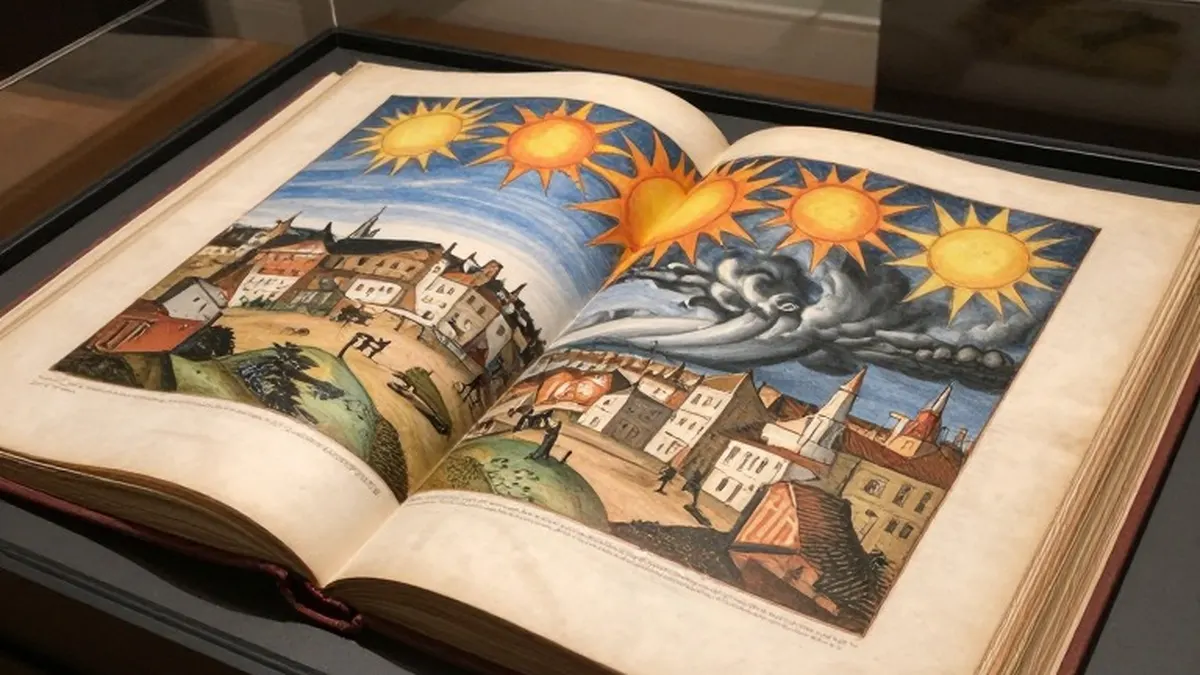
A 16th-century illustrated manuscript filled with extraordinary weather, celestial spectacles and visions of catastrophe is expected to sell for between £700,000 and £1m in London on 10 December. The Book of Miracles will lead Christie’s valuable books and manuscripts auction, with public viewing available for six days before the sale.
Produced in Augsburg in the 1550s, the manuscript contains 167 paintings and is the only known copy. Its original purpose remains uncertain. The auction will be the first opportunity for public institutions to bid for it since scholars became aware of its existence, after it had remained unknown to them for almost 500 years.
The book emerged from the library of a small baroque castle in southern Germany nearly two decades ago. It was auctioned in 2008 with the castle’s furniture, carpets and tankards, selling for just over £100,000. Soon afterwards, it joined the private collection of Mickey Cartin, one of Connecticut’s leading collectors of contemporary art.
Its watercolour and gouache illustrations include five suns above Leipzig in 1551, blood rain over Rome in 1456 and huge hailstones striking Dordrecht in 1552 during a storm that prompted fears of Judgment Day. Other scenes show locusts reaching Poland in 1527 and the North Sea flooding the Frisian coast in 1230. German captions beneath the paintings identify the events, their locations and their dates.
Eugenio Donadoni, Christie’s international specialist in medieval and Renaissance manuscripts, described the work as an “exceptionally rare” German wonderbook. Such books served as sensational media and were used by Lutheran theologians, including Martin Luther and Philip Melanchthon, to advance Protestant ideas about the end of the world, he said. Their attention to witnesses, dates and locations also helped establish practices of observation and reporting.
Donadoni said the manuscript reflects both anxiety about the future and growing curiosity about observable phenomena during a period of religious division. Its artists drew on broadsheets, chronicles and histories to depict events regarded as warnings. Some images have scientific interpretations: the Leipzig scene is thought to show a parhelion, or sun dog, while scholars believe dragons pictured above Bavaria in 1533 represent the northern lights. Blood rain results when red dust particles, usually from the Sahara, mix with droplets in rain clouds.
The vivid imagery could appeal to buyers of modern as well as historical art, Donadoni said, comparing some scenes to surrealist work. He also likened the experience of turning its pages in the 1550s to consuming a stream of alarming social media posts, calling it a possible “16th-century version of doomscrolling”.
Till-Holger Borchert, director of the Suermondt Ludwig Museum in Aachen, has studied the manuscript and considers the £1m valuation conservative, suggesting the sale could achieve considerably more. He said a facsimile published in 2013 generated excitement and helped make the book an icon among people interested in apocalyptic subjects. For Borchert, its appeal extends beyond its historical importance to the response it provokes in viewers.